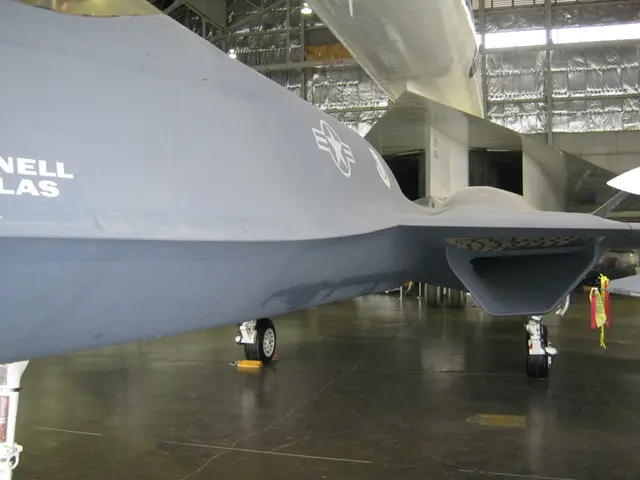
The enigmatic sea creature from the Caspian Sea, rumored to be of Soviet origin, left American intelligence analysts bewildered.
Ground Effect Vehicles (GEVs): A New Era of High-Speed Logistics
Ground Effect Vehicles (GEVs) are a revolutionary form of transportation that exploit the increased lift and efficiency from flying extremely close to a surface, usually water. These vehicles have gained attention for their potential in military applications, particularly for rapid logistics, amphibious assault operations, and high-speed transport in contested maritime zones.
Current State and Developments
China has been actively developing GEVs, with recent images revealing a gray vehicle equipped with short wings and four top-mounted engines. This vehicle is believed to be designed for rapid logistical support, with potential military applications in contested maritime zones, such as the Taiwan Strait. China is also recruiting expertise from former Soviet ground effect vehicle programs, indicating a serious investment in reviving or advancing this technology for military purposes [3].
The United States' efforts in GEV development are represented by DARPA's "Liberty Lifter" project, which aimed to revolutionize heavy-duty air transport. Although a prototype is no longer planned, DARPA intends to transfer the research findings to other platforms, suggesting the U.S. military is leveraging insights from GEV development indirectly. There are also active private-sector projects in the U.S. exploring ground effect vehicles [3].
Potential Military Applications
Both nations could use GEVs for swiftly moving supplies and equipment just above the water surface, bypassing slower ship transport and potentially avoiding some threats that affect aircraft and traditional naval vessels. For China, GEVs may be crucial in operations where speed and stealth are required to reinforce island positions or conduct amphibious landings.
Comparison with Other Autonomous and Robotic Military Technologies
While GEVs offer a niche transport capability, both China and the U.S. are more broadly focusing on autonomous ground vehicles and robotic systems that support soldiers directly on the battlefield. The U.S. Army recently tested fully autonomous ground vehicles like the Overland AI ULTRA, designed to carry supplies and evacuate wounded personnel autonomously, enhancing soldier safety [1][5]. China's military similarly emphasizes autonomy with AI-driven drone swarms, robotic artillery, and self-driving tanks [2].
Summary
China is actively developing operational GEVs for fast, hard-to-detect maritime transport that supports amphibious warfare and island resupply. The U.S. has conducted advanced research and prototype work on GEVs but has shifted focus towards leveraging research outcomes in other platforms. The U.S. is also advancing autonomous ground vehicle technologies to reduce frontline soldier risk.
Both countries value autonomous systems highly, but GEVs remain a specialized solution primarily for rapid transport above water surfaces rather than direct frontline engagement. This places Ground Effect Vehicles in a strategic role of high-speed logistical and amphibious support, especially in maritime contested zones like the Indo-Pacific theater involving China and the U.S. military forces [3][1][5][2].
The U.S. Defense Advanced Research Projects Agency (DARPA) was exploring ground effect vehicle technology through the Liberty Lifter program. However, DARPA has ended the Liberty Lifter project, but is working with the defense industry to implement findings as quickly as possible. It's important to note that the Soviet Union's ekranoplans were much larger than those developed today.
[1] https://www.army.mil/article/258243/army_completes_first_fully_autonomous_ground_vehicle_test [2] https://www.scmp.com/news/china/military/article/3123542/china-unveils-swarm-ai-powered-drones-capable-flying-formation [3] https://www.defensenews.com/space/2021/03/09/darpa-is-building-a-futuristic-ground-effect-vehicle-for-military-use/ [5] https://www.defenseone.com/technology/2021/03/army-tests-autonomous-ground-vehicle-carrying-wounded-soldiers/172386/
- What could potentially distinguish Ground Effect Vehicles (GEVs) from other autonomous and robotic military technologies? They offer a niche transport capability primarily for high-speed logistical and amphibious support in maritime contested zones, unlike direct frontline engagement.
- With China actively developing operational GEVs, it raises questions about the potential role of science and technology in enhancing military capabilities. These vehicles, designed for fast, hard-to-detect maritime transport, could support amphibious warfare and island resupply, offering advantages over traditional naval vessels in speed and stealth.
- As the United States shifts focus towards leveraging research outcomes from the Liberty Lifter program in other platforms, the importance of cybersecurity and data-and-cloud-computing becomes apparent. Ensuring the security and reliability of these complex systems is crucial to preventing potential threats and ensuring operational efficiency.
- The development and refinement of ground effect vehicle technology could have significant implications for the industry and finance sectors. With China investing in reviving or advancing this technology for military purposes, there may be opportunities for collaboration and partnerships in the industry, driving advancements and innovation in this emerging field of technology.