The Law of Demand: Its Operations and Mechanisms
In the realm of economics, two unique categories of goods challenge the traditional Law of Demand: Giffen goods and Veblen goods. These exceptions, named after economists Robert Giffen and Thorstein Veblen, offer intriguing insights into consumer behaviour and market dynamics.
Giffen goods, defined as inferior goods, are products whose demand increases as their price rises. This anomaly arises when the income effect overpowers the substitution effect. For instance, in times of increased prices for a staple food, consumers tend to spend less on luxury goods and more on the staple to meet their basic needs.
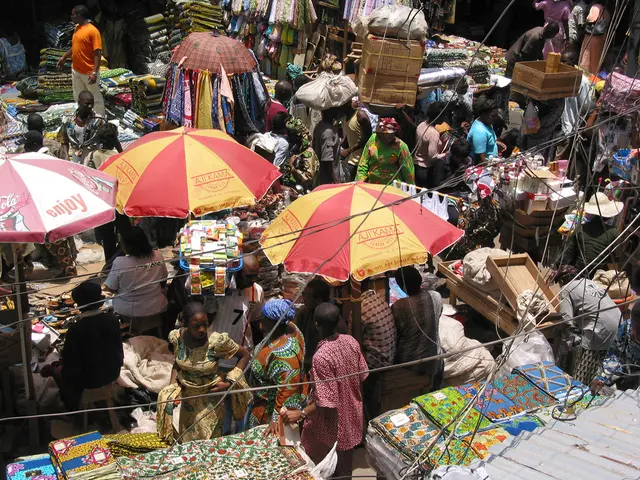
One historical example of Giffen goods is potatoes during the Irish Potato Famine. As the price of potatoes soared, people purchased more of them and fewer luxury items, as potatoes were a vital food source. Another example can be seen in very poor households, where an increase in the price of staple foods such as Bajra may result in these households spending more on them while cutting back on other, more expensive foods.
On the other hand, Veblen goods are luxury or status goods whose demand increases as their price rises. The allure of these goods lies in their high price, which often signifies status or exclusivity. Examples of Veblen goods include designer watches, high-end cars, luxury jewelry, and exclusive clothing brands. The higher the price, the more desirable these goods become, as they are perceived as status symbols.
Both Giffen and Veblen goods violate the traditional Law of Demand, with Giffen goods being related to necessity, and Veblen goods being associated with status and luxury. The Law of Demand, a principle in microeconomics, generally states a negative relationship between a good's price and its quantity demanded. This relationship can be visualised by plotting the quantity demanded for each different price level on a curve.
For consumers, price plays a significant role in their satisfaction, representing the costs they must incur to meet their needs and wants. Meanwhile, for producers, the goal is to maximise profits, with price being a crucial factor that affects their profits. The interaction between producers and consumers in the market ultimately determines the equilibrium price, which is the best price for both parties.
[1] Source: "Microeconomics" by Gregory Mankiw, Chapter 5, Section 5.2 [4] Source: "Economics" by Paul Krugman and Robin Wells, Chapter 5, Section 5.2
In the realm of finance and business, the demand for Giffen goods, such as staple food items like potatoes or Bajra, increases as their price rises due to a higher priority assigned to these essential goods. Conversely, the demand for Veblen goods, like luxury items such as designer watches or exclusive clothing brands, escalates when their prices soar, as a higher price often signifies status and exclusivity.